
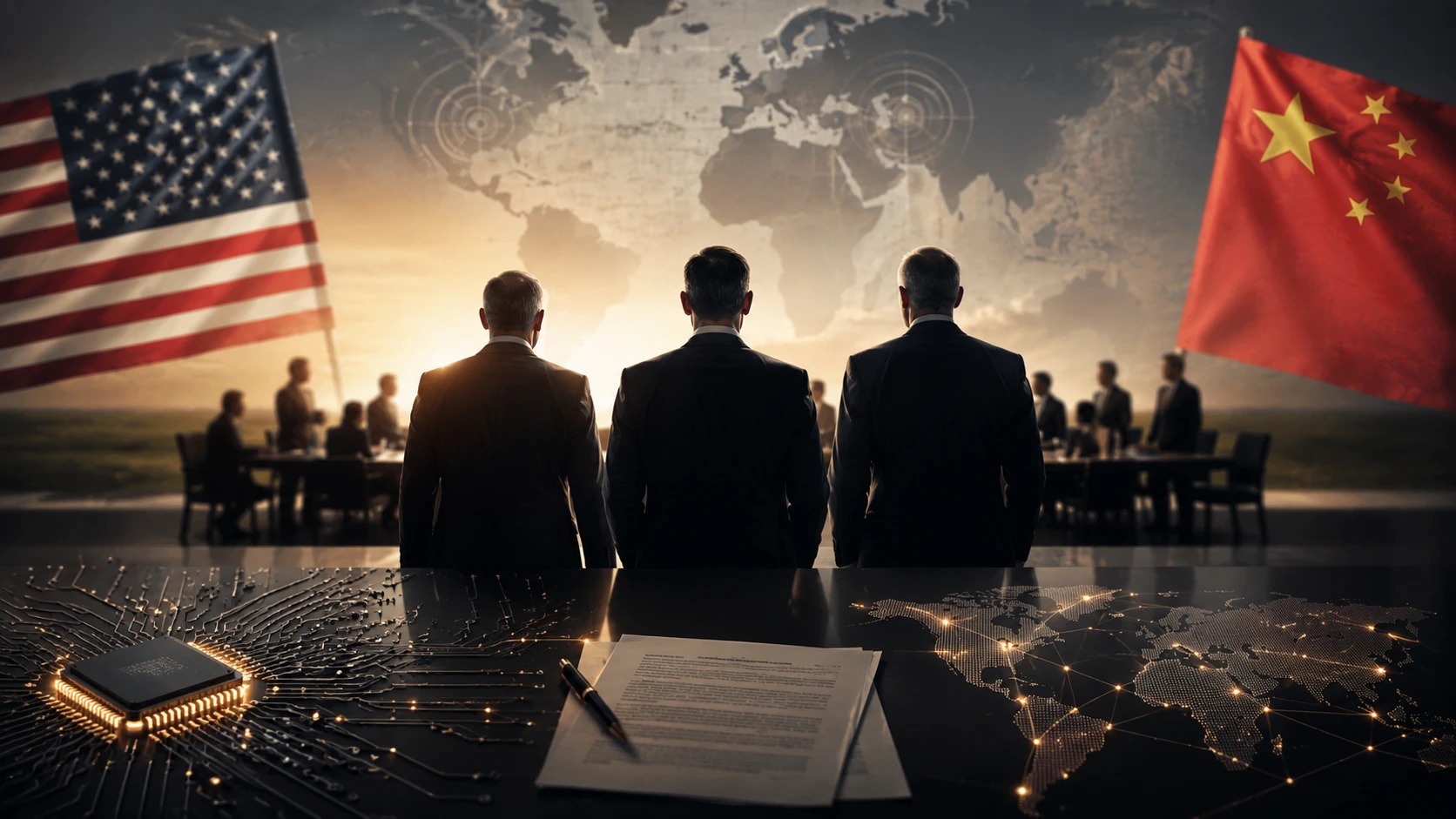
On May 12, 2026, President Donald Trump boarded Air Force One at Andrews Air Base, Maryland, accompanied by a delegation with no precedent in the history of American tech diplomacy: 16 CEOs from the most influential companies in the world, including the leaders of the three most valuable technology companies on the planet.
On the plane were Elon Musk (Tesla and SpaceX), Tim Cook (Apple) and Jensen Huang (Nvidia) — three figures whose decisions directly impact the technology war between the United States and China. Also traveling were Dina Powell McCormick (Meta), Jane Fraser (Citigroup), David Solomon (Goldman Sachs), Larry Culp (GE Aerospace), Sanjay Mehrotra (Micron Technology), Cristiano Amon (Qualcomm) and Brian Sikes (Cargill), among others.
Trump landed in Beijing on Wednesday, May 13. The main summit with Chinese President Xi Jinping took place on May 14 at the Great Hall of the People, with a state banquet and a visit to the Temple of Heaven included.
Why they went
The visit has three overlapping layers: trade, artificial intelligence and geopolitics.
Trade: Trump wants China to buy more American soybeans, beef and aircraft. The stated goal is to create a bilateral Trade Board to resolve tariff differences in a structured way. The White House clarified there was no comprehensive deal on the table — the visit was to start the process, not close it.

Artificial intelligence and chips: The presence of Jensen Huang (Nvidia) and Cristiano Amon (Qualcomm) in the delegation was no coincidence. Export restrictions preventing China from accessing Nvidia's most advanced chips — including the RTX 4090, H100 and their successors — are the sharpest point of technological tension between the two countries. Trump said he wants China to "open up" for American companies to operate freely. The question hanging over the entire visit is whether that could include some easing of chip export restrictions — something Nvidia needs to recover its Chinese market where its share has fallen below 60%.
Taiwan and Iran: The two most sensitive geopolitical items on the agenda. Chinese Foreign Minister Wang Yi declared after the summit that Beijing "perceived that the American side understands China's position" on Taiwan — a statement Washington neither confirmed nor publicly denied. On Iran, Trump had promised to talk with Xi about the war in the Strait of Hormuz, through which 45% of China's gas and oil imports pass.
Why each CEO went
Elon Musk: Tesla has significant operations in China — its Shanghai Gigafactory is one of the most productive in the world. Musk had stepped away from his Trump advisor role in May 2025, but the visit showed his realignment with the administration when his companies' interests are at stake.
Tim Cook: Apple manufactures most of its products in China. The tariffs imposed during Trump's first term hit Apple's supply chain directly. Cook has a direct interest in stabilizing the trade relationship between both countries.
Jensen Huang: The Nvidia CEO is the most directly affected by chip export restrictions. Nvidia's China sales dropped dramatically since Washington banned the export of its most advanced chips. His presence in the delegation is the clearest signal that the future of semiconductors in the Chinese market was on the table.
What was agreed
The summit didn't produce a single major deal. What emerged was a framework for future negotiations: the process to establish the bilateral Trade Board, signals of dialogue on artificial intelligence, and the promise that Xi Jinping will visit the United States at a later date.
Russia watched closely — Kremlin spokesman Dmitry Peskov noted that US-China contacts "are subject to special attention and analysis by all countries, including ours."
Trump's political context
The visit came at a delicate moment: his popularity is weighed down by the US-Israel war against Iran and the inflation spike that conflict generated. A diplomatic win with China carries domestic political value. On the return trip, Trump posted on Truth Social that China has an impressive ballroom and that the US should have one too — and that the one he's building at the White House is "ahead of schedule."


Comments
💬 Log in to comment💬 Join the conversation and log in to comment.