
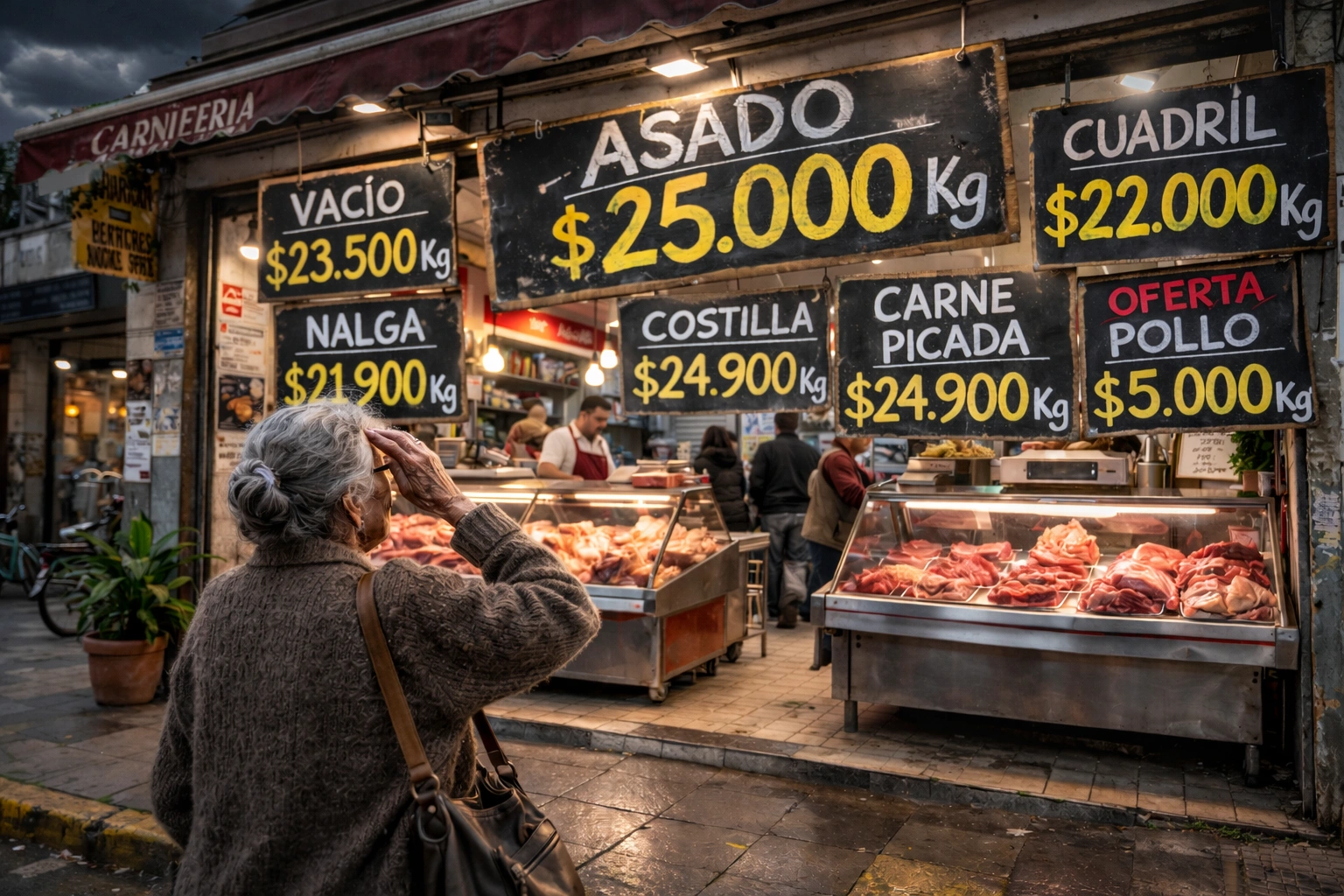
Beef has once again taken center stage in Argentina’s economic debate. Over recent weeks, butcher shops and supermarkets have updated price lists with increases ranging between 15% and 20% during February. The surge is not only impacting consumers at the counter but also contributing to broader inflation trends.
Industry representatives report that the price of asado — one of Argentina’s most traditional cuts — now exceeds ARS 25,000 per kilo in many areas. Other popular cuts such as round steak and flank have also seen notable increases, putting additional pressure on household budgets.
Renewed Pressure on Household Spending
After significant adjustments throughout 2025, the beginning of 2026 brought a new wave of price acceleration. Retailers describe a volatile scenario, with updated wholesale prices arriving frequently.
Families are responding by reducing purchase volumes or turning to more affordable alternatives such as pork and chicken. Restaurants and steakhouses are also adjusting menus to cope with higher input costs.
Key Drivers Behind the Price Surge
The current price escalation results from a combination of structural and short-term factors.
### Reduced Cattle Supply
One of the primary causes is a limited supply of cattle ready for slaughter. Producers held back livestock in previous months, anticipating improved prices. As a result, fewer animals entered the market in the short term.

When supply tightens while demand remains stable, wholesale and retail prices naturally increase.
### Strategic Retention by Producers
In an inflationary environment, producers often delay sales expecting further gains. Holding cattle longer can be financially advantageous if prices continue rising, but this strategy temporarily reduces market availability.
### Strong Export Demand
International demand for Argentine beef remains solid. Export markets, often paying in U.S. dollars, compete with domestic buyers for the same production volume.
When exports absorb a substantial share of output, the domestic market faces reduced supply and higher prices.
### Rising Production Costs
Beef production involves significant expenses: feed, transportation, energy, labor and veterinary care. Cumulative increases in these areas push producers to adjust selling prices.
Unlike other proteins, cattle production cycles are lengthy, meaning supply cannot expand quickly in response to short-term demand spikes.
### Weather-Related Challenges
Recent climatic events affected pasture conditions in key producing regions. Limited natural feed availability can slow weight gain and reduce the number of animals ready for processing.
Although weather is not the sole driver, it plays a relevant role in the overall production cycle.
Inflationary Impact
Economists estimate that beef price increases could add up to 0.5 percentage points to February’s consumer price index. Given beef’s weight in Argentina’s consumption basket, fluctuations have immediate macroeconomic consequences.
Beyond affecting weekend barbecues, higher beef prices ripple through the broader food category, influencing overall living costs.
Shifting Consumption Patterns
Per capita beef consumption has shown signs of adjustment. Faced with rising prices, consumers increasingly opt for poultry or pork, which remain comparatively more affordable.
While beef remains culturally central to Argentina’s identity, purchasing habits are adapting to economic constraints.
Outlook for the Coming Months
Industry experts caution that price corrections may not occur quickly. Cattle production cycles require time to rebuild supply levels.
If supply stabilizes and domestic demand weakens, some moderation could emerge. However, as long as export demand remains strong and production costs stay elevated, market tensions are likely to persist.
For now, beef prices remain a sensitive indicator of Argentina’s economic landscape in 2026, reflecting both structural challenges and immediate market pressures.




Comments
💬 Log in to comment💬 Join the conversation and log in to comment.