
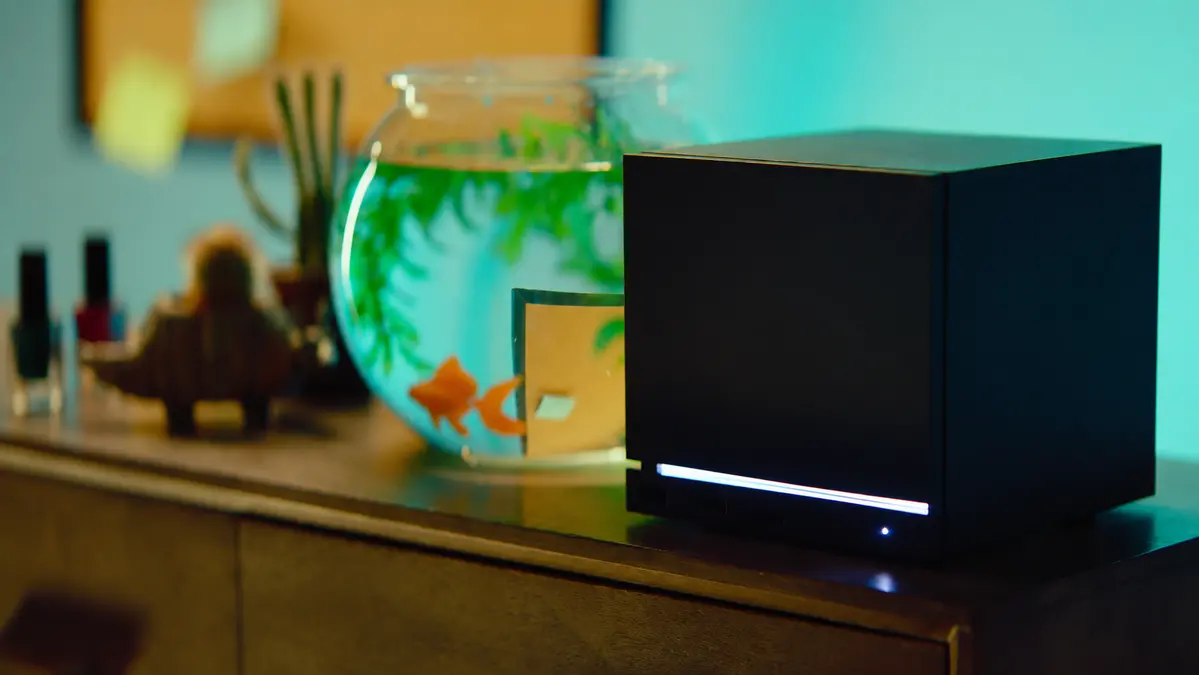
The new Steam Machine is not trying to win a price war against PlayStation or Xbox.
That becomes clear once the full hardware picture is visible. Valve is selling a compact living-room gaming PC built around SteamOS, custom AMD silicon and the Steam ecosystem. It may look like a console from the outside, but the inside tells a different story.
With prices starting at USD 1,049 for the 512 GB model, rising to USD 1,349 for the 2 TB version and reaching USD 1,428 when bundled with the Steam Controller, the Steam Machine enters premium gaming PC territory.
That is exactly why the comparison with PS5 Pro has become so intense.
What the Steam Machine actually is
The Steam Machine is Valve's second major attempt to bring PC gaming into the living room.
The original concept failed years ago because the software was not ready, the hardware ecosystem was fragmented and Windows still dominated PC gaming. In 2026, Valve is trying again from a much stronger position.
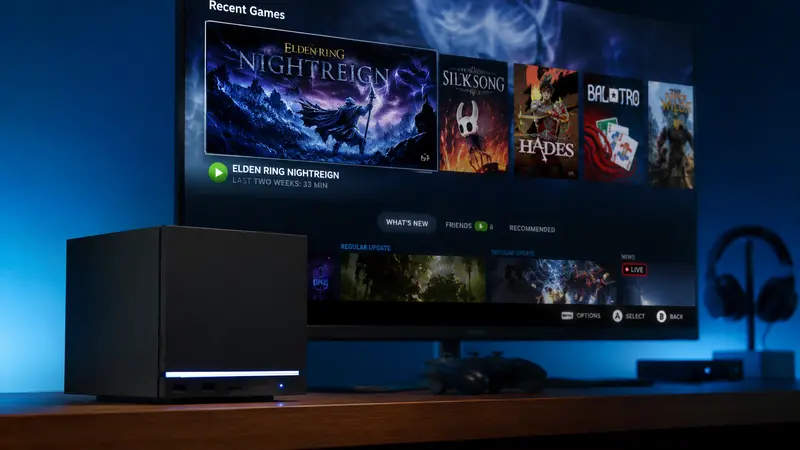
Steam Deck changed everything.
It proved that SteamOS could become a real gaming platform, not just an experiment. The new Steam Machine takes that same idea and turns it into a more powerful device designed for TVs, controllers and living-room setups.
It is not a closed console.
It is a small PC designed around Steam.
Custom AMD CPU
Valve confirmed that the system uses a semi-custom AMD processor based on Zen 4.
The CPU includes:
- 6 cores.
- 12 threads.
- Up to 4.8 GHz.
- 30 W TDP.
That configuration is not meant to beat high-end desktop processors. Instead, it is designed for efficiency, thermal control and stable gaming performance inside a small chassis.
For a living-room device, that balance matters. A machine like this cannot behave like a full-size tower with unrestricted cooling and power.
RDNA3 graphics with dedicated VRAM
The GPU is also semi-custom AMD hardware.
Valve lists:
- RDNA3 architecture.
- 28 compute units.
- Sustained clock up to 2.45 GHz.
- 110 W TDP.
- 8 GB of GDDR6 VRAM.
This is one of the most important differences between the Steam Machine and basic mini PCs.
Valve is not relying on weak integrated graphics. The system includes a dedicated graphics solution with its own memory, making it closer to a compact gaming PC than a standard living-room box.
The 8 GB of VRAM should be enough for many modern games, although demanding 4K titles will likely depend heavily on upscaling and optimized settings.
Memory and storage
The system includes:
- 16 GB of DDR5 RAM.
- 8 GB of GDDR6 video memory.
- 512 GB NVMe SSD or 2 TB NVMe SSD.
- High-speed microSD card slot.
This gives the Steam Machine a more PC-like memory structure than many consoles.
System memory and video memory are separated, which helps the GPU handle game assets without sharing the same pool as the operating system and background tasks.
Storage will be a major decision for buyers. The 512 GB model is cheaper, but modern PC games can be massive. For players with large Steam libraries, the 2 TB model will likely be the more practical choice.
Display output and modern TVs
Valve gave the Steam Machine serious display flexibility.
The device includes DisplayPort 1.4 with support for:
- up to 4K at 240 Hz.
- up to 8K at 60 Hz.
- HDR.
- FreeSync.
- daisy chain.
It also includes HDMI 2.0 with support for:
- up to 4K at 120 Hz.
- HDR.
- FreeSync.
- CEC.
That matters because this is a device built for both monitors and living-room televisions. The HDMI output makes sense for TVs, while DisplayPort gives it more flexibility for PC-style setups.
FreeSync support is also important for smoother gameplay when frame rates fluctuate.
Ports and connectivity
The port selection is practical.
The Steam Machine includes:
- Two front USB-A 3.2 Gen 1 ports.
- Two rear USB-A 2.0 ports.
- One rear USB-C 3.2 Gen 2 port.
- Gigabit Ethernet.
Wireless connectivity includes:
- Wi-Fi 6E 2x2.
- Dedicated Bluetooth 5.3 antenna.
- Built-in 2.4 GHz wireless adapter for Steam Controller.
The integrated Steam Controller adapter is a smart move. It suggests Valve wants lower latency and stronger reliability than a standard Bluetooth-only controller connection.
RGB LED strip
The front LED strip is more than a visual gimmick.
Valve says the Steam Machine includes 17 individually configurable RGB LEDs that can show system status or be customized by the user.
That means the strip can represent download progress, system activity or simply serve as a visual identity feature.
Users who dislike it can also turn it off.
Size and weight
The Steam Machine is compact, but not tiny.
Valve lists the following dimensions:
- 152 mm tall.
- 148 mm tall without feet.
- 162.4 mm long.
- 156 mm wide.
- 2.6 kg.
It is essentially a small cube-shaped gaming PC.
That makes it much easier to place near a TV than a traditional desktop, but it is still a real piece of hardware, not a streaming box.
SteamOS 3 and KDE Plasma
Software may be the biggest reason this product exists.
The Steam Machine runs SteamOS 3, based on Arch Linux, with KDE Plasma as its desktop environment.
This is where Valve has a major advantage compared to the original Steam Machines. SteamOS is now backed by years of Steam Deck development, Proton compatibility improvements and a growing catalog of verified or playable games.
The main experience is console-like, but the underlying system remains much more open than a traditional console.
Why it costs more than PS5 Pro
The price is easier to understand once the Steam Machine is compared to compact gaming PCs instead of consoles.
A PS5 Pro benefits from Sony's enormous manufacturing scale, fixed hardware design and closed ecosystem economics. Console makers can often accept smaller hardware margins because they recover money through software sales, subscriptions and platform fees.
Valve is approaching this differently.
The company has said it does not want to heavily subsidize hardware because that would push the product toward a more closed console-style business model.
The Steam Machine is priced more like a PC because it is being sold more like a PC.
Who should buy it?
The Steam Machine is not for everyone.
Console buyers who simply want the cheapest path to modern gaming may still be better served by PlayStation or Xbox.
But the device becomes much more interesting for players who:
- already own large Steam libraries.
- want to play on a TV.
- prefer SteamOS over Windows.
- use mods.
- value PC flexibility.
- want a compact ready-made system.
For that audience, the Steam Machine offers something a console cannot.
Conclusion
The Steam Machine is expensive if it is judged only as a console.
But that is not really what Valve built.
This is a compact Steam-focused gaming PC with AMD Zen 4 CPU, RDNA3 graphics, 16 GB DDR5 RAM, 8 GB GDDR6 VRAM, NVMe storage, Wi-Fi 6E, Bluetooth 5.3, Gigabit Ethernet, modern video outputs and SteamOS 3.
Its biggest challenge will be convincing buyers that paying more than a PS5 Pro makes sense.
For regular console players, that may be difficult. For dedicated Steam users who want their PC library in the living room without building a machine themselves, Valve finally has a much stronger argument than it did in 2015.




Comments
💬 Log in to comment💬 Join the conversation and log in to comment.