
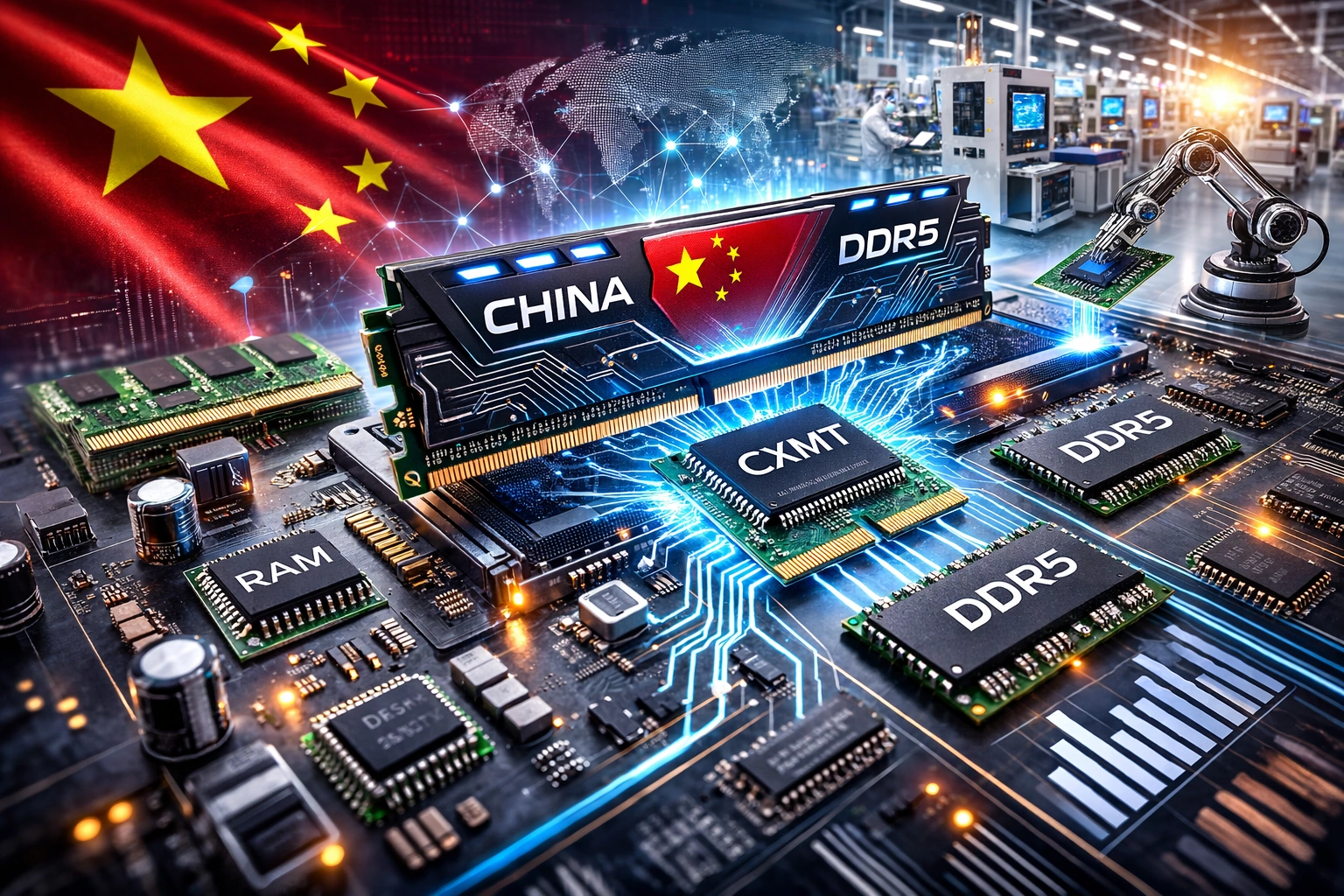
China is rapidly strengthening its domestic RAM memory industry and positioning itself as a serious competitor in the global semiconductor market. For decades, memory production was dominated by companies from South Korea, the United States, and Japan. Today, China is working to reduce its dependence on foreign suppliers and build a self-sufficient technology ecosystem.
This strategy is driven not only by economic interests but also by national security and geopolitical concerns. Trade conflicts and export restrictions have pushed the country to invest heavily in chip manufacturing and research.
A strategic push for technological independence
One of China’s main goals is to achieve independence in key components such as DRAM and NAND memory. These technologies are essential for computers, servers, smartphones, consoles, and cloud infrastructure.
In the past, China was one of the world’s largest memory consumers, yet relied almost entirely on imports. This created vulnerabilities in times of political tension.

To address this, the government launched large-scale investment programs focused on factories, research centers, and specialized engineering training.
Leading domestic manufacturers
ChangXin Memory Technologies, known as CXMT, is currently the most important Chinese DRAM producer. The company has developed chips compatible with modern standards such as DDR4 and DDR5, reaching speeds above 5600 MHz in internal testing.
In the NAND sector, Yangtze Memory Technologies Co (YMTC) has made significant progress with multilayer storage technology and proprietary designs.
Both companies receive strong state support and operate within a growing industrial ecosystem.
Performance and system compatibility
Chinese-made RAM modules are now compatible with modern motherboards and processors from major manufacturers. Tests conducted in Asian markets show that DDR5 modules produced in China can reach performance levels similar to established brands.
Although there are still differences in latency, long-term stability, and advanced memory profiles, the technological progress is undeniable.
For everyday users and businesses, these products already deliver adequate performance.
Impact on pricing and competition
China’s entry into the high-performance memory market is reshaping competition. More manufacturers mean stronger price pressure across the industry.
Market analysts believe that Chinese RAM could help reduce average DDR5 prices in emerging markets over the next few years.
This could benefit consumers, PC builders, and small businesses seeking affordable upgrades.
Adoption in laptops, servers, and mobile devices
Most Chinese-produced memory is currently used within the domestic market. Many laptops, mini PCs, and servers sold in Asia already include locally manufactured RAM.
In data centers, Chinese memory is mainly deployed in government-related and state-backed infrastructures.
In smartphones, adoption remains limited but is expected to grow gradually.
Technical and reputation challenges
Despite rapid progress, Chinese memory manufacturers still face major challenges. Global brands such as Samsung, SK Hynix, and Micron benefit from decades of experience and established trust.
Advanced manufacturing processes below 15 nanometers remain difficult to replicate without full access to Western equipment.
Concerns about long-term reliability and global technical support also persist.
Geopolitical restrictions and trade barriers
Export controls imposed by the United States and its allies restrict China’s access to advanced chip-making machinery.
In response, China has invested in domestic alternatives and optimized existing production technologies.
As a result, memory manufacturing has become a key battlefield in the global technology race.
Future outlook for the sector
Experts estimate that by 2028, China could supply between 20% and 25% of its domestic DRAM demand through local production.
If current investment levels continue, the country may also become a major exporter in the coming years.
These developments will be crucial for artificial intelligence, gaming, cloud computing, and smart vehicles.
What this means for users
For end users, the rise of Chinese RAM means more options and potentially lower prices.
In the short term, these products are attractive for budget systems and basic upgrades.
In the medium term, they may become competitive alternatives even for gamers and professionals.
China’s ambition goes far beyond producing memory chips. It aims to build a complete semiconductor ecosystem capable of competing globally. The rapid progress in RAM technology shows that this goal is becoming increasingly realistic.


Comments
💬 Log in to comment💬 Join the conversation and log in to comment.