
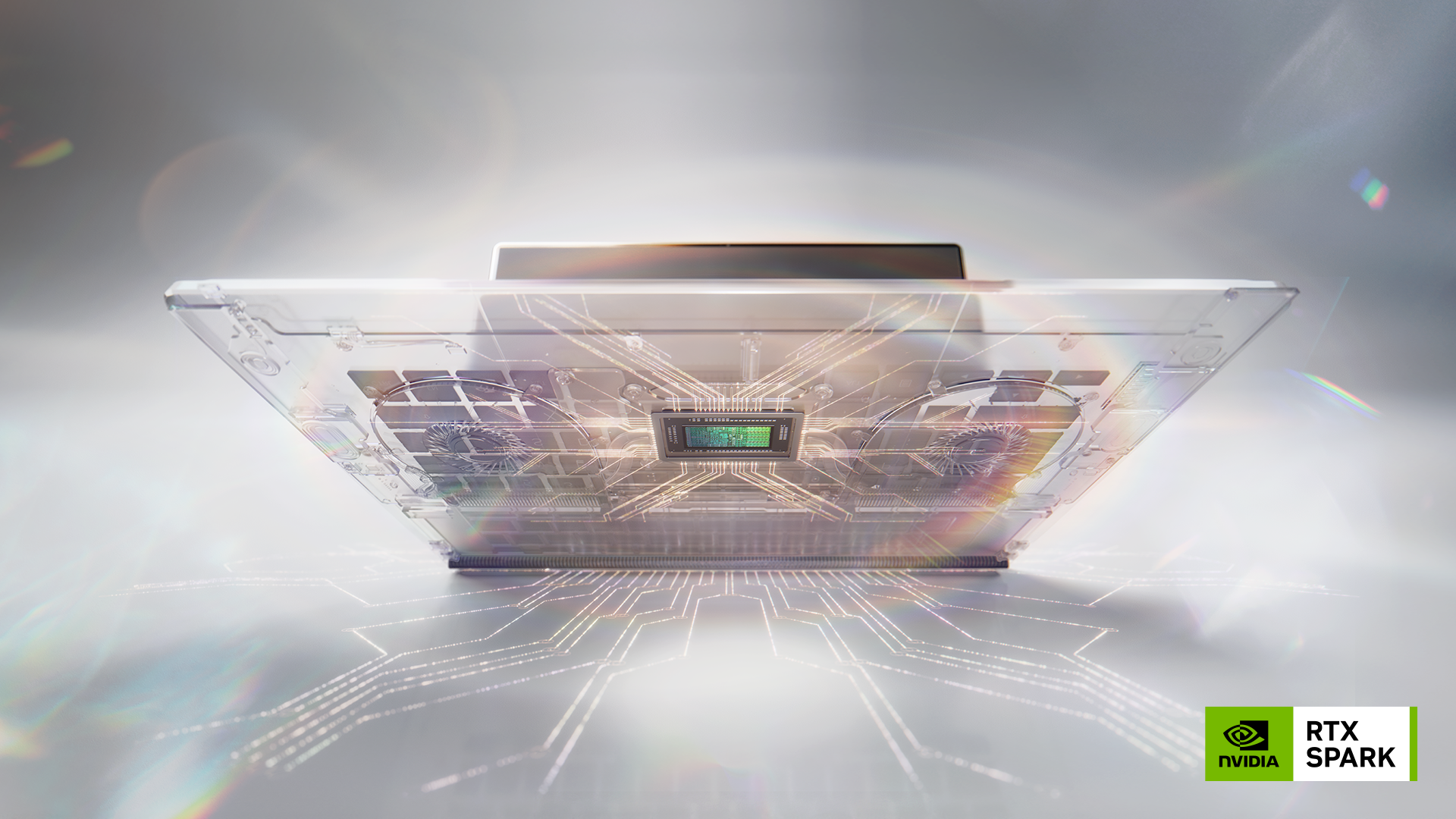
The laptop chip market has been shaken up twice in two years. Qualcomm's Snapdragon X Elite broke Intel and AMD's stranglehold on Windows PCs. Now NVIDIA is making a move that goes further than anything Qualcomm attempted.
RTX Spark is not a companion chip or a co-processor bolted onto someone else's CPU. It's a full SoC — System on a Chip — that puts NVIDIA's Blackwell GPU architecture, a 20-core ARM CPU co-developed with MediaTek, and up to 128GB of LPDDR5X unified memory into a single package built on TSMC's 3nm process. Power consumption scales from 10W to 80W depending on load. Declared AI inference performance: 1 petaFLOP FP4.
The target is explicit. NVIDIA wants to be the Windows answer to Apple Silicon M4 and M5 — thin, powerful, AI-capable and fast enough for serious gaming without a discrete GPU.
What the hardware actually delivers
Two variants are confirmed for the RTX Spark launch:
N1 — the standard configuration. 20-core ARM CPU, Blackwell GPU with 6,144 CUDA cores, up to 128GB unified LPDDR5X memory. Confirmed gaming at 1440p. Full DLSS 4.5, real-time ray tracing and NVIDIA's AI tool stack included.
N1X — the higher-performance variant aimed at creators and workstation users. Same architecture, higher configuration. Morgan Stanley's estimated entry price: $2,899.
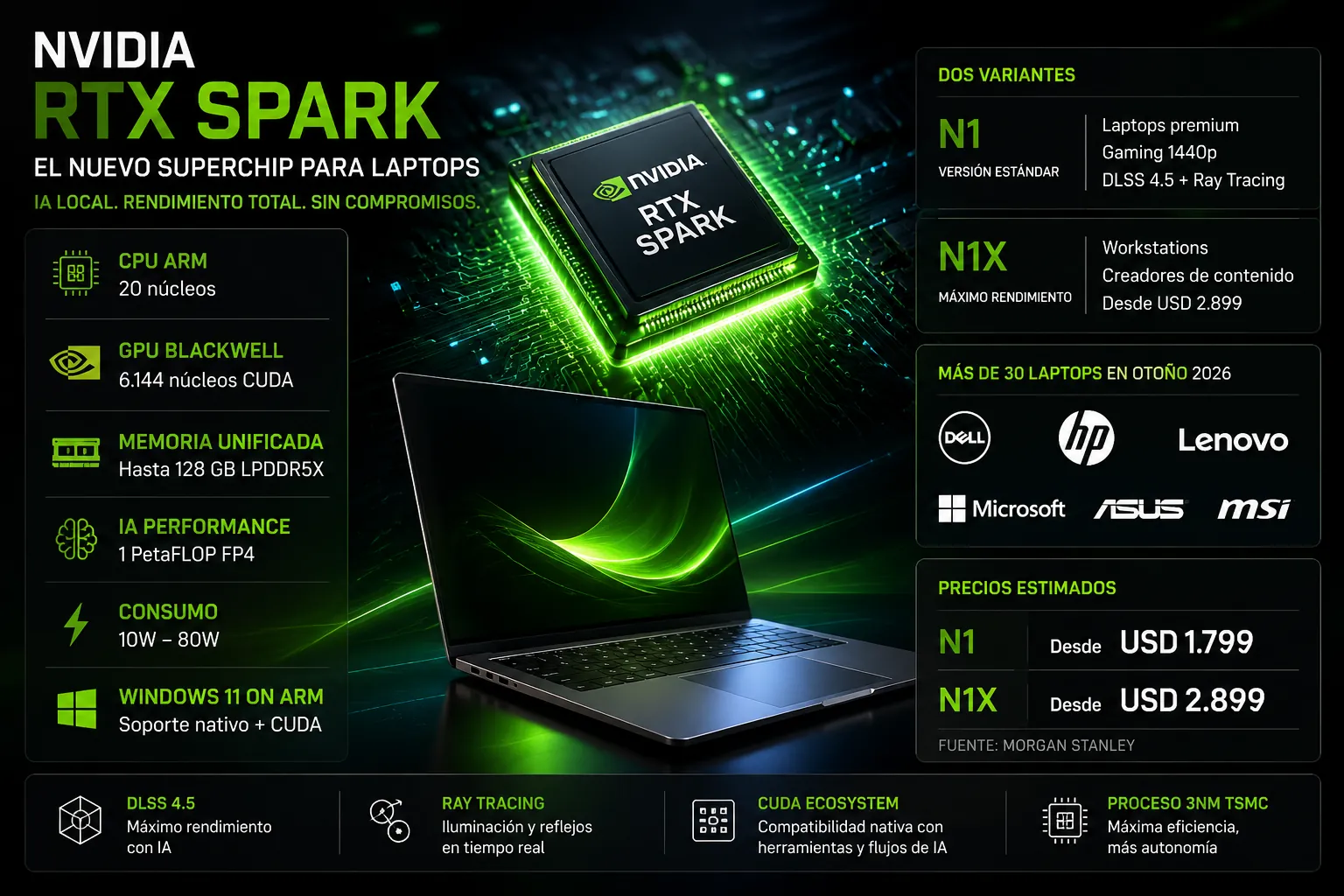
Both variants run Windows 11 on ARM with native access to NVIDIA's CUDA ecosystem — meaning AI workflows built for NVIDIA hardware run without compatibility layers or emulation overhead.
The CUDA argument nobody else can match
Apple Silicon is fast. Qualcomm Snapdragon X Elite is efficient. Neither of them runs CUDA natively.
Decades of AI models, creative software and game engines are optimized for NVIDIA's CUDA architecture. RTX Spark laptops inherit that entire ecosystem without translation layers. For anyone running AI inference locally, doing video work in DaVinci Resolve, or training small models on-device, that's a meaningful practical advantage.
Gaming is the other differentiator. Apple Silicon Macs have made real progress — Cyberpunk 2077 at 120 FPS on M4 Max was a genuine headline — but those numbers depend heavily on upscaling and frame interpolation. RTX Spark brings the actual Blackwell gaming architecture to a thin chassis, with real ray tracing and DLSS 4.5. No current competitor combines that.
30+ laptops coming this fall
Dell, HP, Lenovo, Microsoft, ASUS and MSI have all confirmed RTX Spark laptops for fall 2026. Microsoft's Surface Laptop Ultra is the highest-profile announcement — a direct successor to the Snapdragon X Elite model currently starting at €1,799. ASUS is bringing the ProArt P14 and P15 for creative professionals. Dell has the XPS 16 in the lineup. Lenovo is covering the thin-and-light productivity angle with the Yoga Pro 9.
Over 30 devices in total. Final pricing for individual models hasn't been announced — that's expected over the next few months as each manufacturer confirms its lineup.
The price problem Morgan Stanley flagged
The technical case for RTX Spark is strong. The business case is harder.
Morgan Stanley published a financial analysis warning that high manufacturing costs will translate directly into high retail prices. Their estimates: N1X models starting at $2,899, N1 models at $1,799. That puts the cheapest RTX Spark laptops in MacBook Pro territory — which is exactly the comparison NVIDIA wants, but also means every benchmark is going to be scrutinized against Apple Silicon performance at the same price point.
The adoption risk is real. Premium hardware at premium prices works for a small segment of users. It doesn't build the broad ecosystem of developers, enterprises and consumers that NVIDIA needs to make RTX Spark a platform rather than a product category.
The unresolved Windows on ARM problem
RTX Spark doesn't fix Windows on ARM's legacy compatibility issues. Software that lacks a native ARM build still runs in emulation, with variable performance penalties. NVIDIA's pitch focuses on new software, AI workflows and recent games — exactly the categories where ARM compatibility is already solved.
Whether that's enough depends on who's buying. For AI developers and content creators working with current tools, RTX Spark is compelling. For anyone with a large collection of older Windows software, the emulation layer remains a friction point no chip can eliminate on its own.



Comments
💬 Log in to comment💬 Join the conversation and log in to comment.