

The year of the Linux desktop has been a running joke for three decades. The punchline stopped being funny sometime in 2025.
Linux desktop market share reached 4.7% globally by the end of 2025, up from 2.76% in July 2022 — a 70% increase in three years. The United States crossed the 5% threshold for the first time in June 2025. India, the world's largest PC market by volume, sits at 16.21%. Google Trends data from February 2026 shows searches for "how to install Linux" at a global all-time high, roughly five times higher than in previous months.
France just announced it's migrating 2.5 million government computers to Linux. Germany's Schleswig-Holstein completed the same transition in 2025 without major incidents. This is no longer a fringe movement.
Microsoft killed Windows 10 and made Windows 11 hostile to older hardware
The most immediate trigger was the end of official support for Windows%2010" title="More about Windows 10">Windows 10 in October 2025. Microsoft stopped issuing security patches. Users on machines that couldn't meet Windows 11's TPM 2.0 and Secure Boot requirements — hundreds of millions of functional PCs — were left with three options: buy new hardware, pay $30 per year for extended security updates, or find an alternative.
Linux Mint, Zorin OS and Pop!_OS don't have those hardware requirements. They run on machines from 2015 and earlier without modification. For anyone sitting on a perfectly working computer that Microsoft declared obsolete, Linux became the obvious escape route.
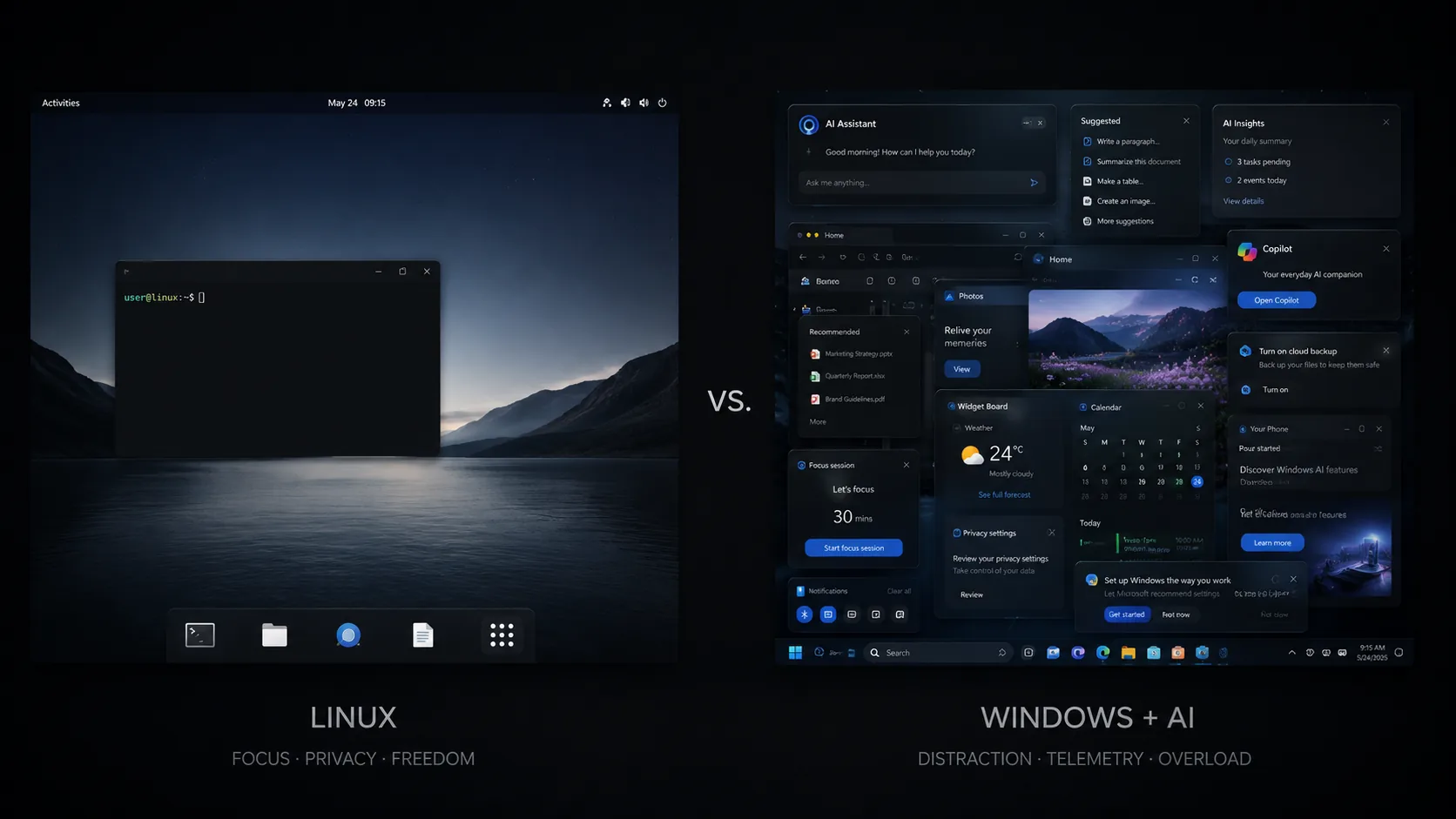
Copilot is everywhere and nobody asked for it
Microsoft baked Copilot into nearly every corner of Windows 11 — real-time screen analysis, automated file manipulation, voice controls, background AI processes running constantly. The features are difficult to disable and in some cases re-enable themselves after system updates.
In early 2026, Microsoft's own consumer Copilot terms of service described the tool as "for entertainment purposes only," advising users not to rely on it for important decisions. This appeared in the terms of service for an AI assistant integrated by default into the world's most widely used productivity operating system.
Linux distributions don't have Copilot. They don't run AI assistants in the background without being asked. The operating system does what the user tells it to do.
The privacy gap is now impossible to ignore
Windows 11's Recall feature uses AI to take automatic screenshots and log everything a user does — text typed, sites visited, documents opened — so Copilot can "remember" it later. The security community's consensus description: built-in spyware at the OS level.
Linux Mint, Fedora, Debian and most mainstream distributions include no telemetry by default. No usage data sent to remote servers, no cloud-synced activity history, no background processes phoning home. For users handling sensitive information — medical, legal, financial — that distinction has become a practical requirement, not a preference.
Better performance on the same hardware
Linux doesn't just run on hardware Windows abandoned — in many cases it runs better on hardware Windows still supports. Multiple 2026 benchmarks show certain AAA titles with higher 1% low FPS on Linux than Windows 11, because the OS runs fewer background processes consuming CPU and RAM.
Valve's Proton translation layer has matured to the point where most Steam titles work on Linux without additional configuration. The Steam Deck normalized the idea that Linux and gaming are compatible. For developers, the Linux terminal environment has always been the professional standard — Windows has been playing catch-up with WSL for years.
Linux is finally easy to use
The historical objection to Linux was always the learning curve. In 2026 that argument has significantly weakened.
Linux Mint's default interface has a taskbar at the bottom, a start menu, system tray icons — the same visual workflow as Windows, without the hardware requirements or the telemetry. Zorin OS ships with a Windows-compatibility mode specifically designed for switchers. KDE Plasma's visual polish is comparable to macOS. Installation on most modern distributions takes under 20 minutes and requires no technical knowledge.
What Linux still can't do
Adobe Photoshop, Premiere and Illustrator have no native Linux versions. Neither does Microsoft Office, though the web version works in any browser. Users dependent on specific Windows-only professional software face a migration that ranges from inconvenient to impossible.
Driver support for very new or very niche hardware can still be problematic. Troubleshooting edge cases still requires more command-line comfort than Windows. And despite the growth numbers, 4.7% global market share means Linux is still a minority platform — with a smaller pool of community support for unusual configurations.
Why this time is different
Previous Linux surges faded because Windows kept the majority of users through inertia. In 2026, Microsoft actively pushed people out — through hardware exclusion, forced AI integration, privacy decisions and a subscription-service direction that many users don't want. Linux didn't win users over. Microsoft drove them to the exit. Linux just happened to be waiting there, and for the first time in its history, it's ready to keep them.


Comments
💬 Log in to comment💬 Join the conversation and log in to comment.