
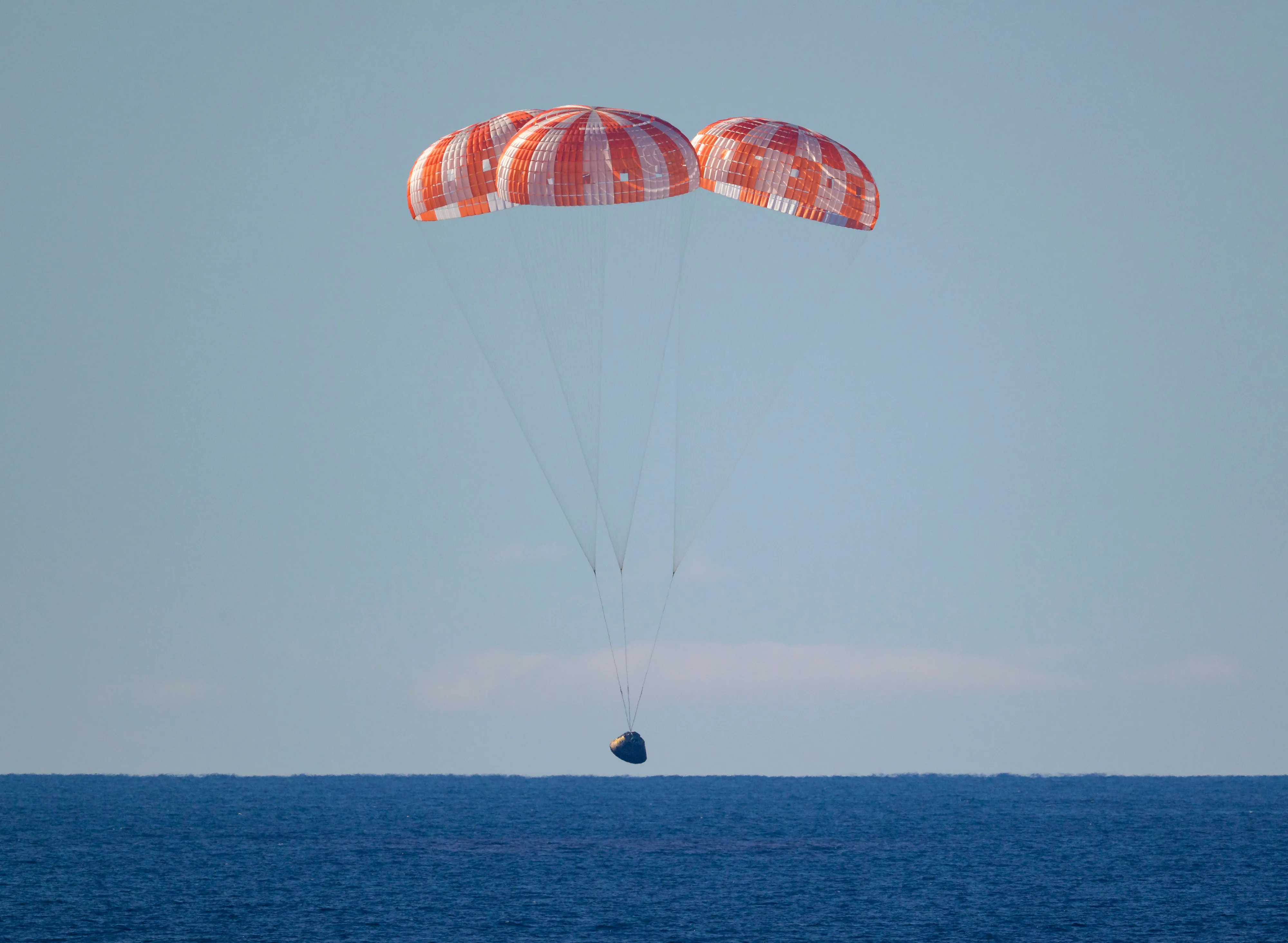
One of the most common questions after Artemis II returned to Earth was also one of the simplest: if the mission had already survived reentry and the capsule was floating safely in the Pacific, why did the crew not just open the hatch and come out right away?
From a distance, the scene can look straightforward. The spacecraft hits the water, parachutes collapse around it, recovery boats move in and the astronauts should be out within minutes. But real spaceflight does not work like that. A splashdown is not an instant finish line. It is the beginning of a carefully managed recovery phase involving NASA, the U.S. military, divers, flight surgeons and helicopter crews.
For Artemis II, NASA logged splashdown at 8:07 p.m. EDT on April 10. Recovery teams began approaching shortly afterward, but the safe extraction of the crew was confirmed much later. That was not a delay in the casual sense. It was the procedure working exactly the way it was designed to work.
Splashdown is only the first safe point
The first thing worth understanding is that once Orion spacecraft touches the ocean, it is not automatically ready for hatch opening and astronaut exit.
NASA said the spacecraft still needed additional checks while in the water. Controllers had to power down nonessential systems and place Orion into a post-landing configuration that made it safe for the recovery teams to move in.
That distinction matters. For the audience, the mission has “made it back.” For the engineers and recovery specialists, the spacecraft is still in a critical phase. The question is not simply how fast the astronauts can leave. The question is whether the environment, the vehicle and the physical condition of the crew make that exit safe.
The area around the capsule is not immediately safe
Another reason astronauts do not exit instantly is that the water around the capsule is not clean and stable right away.
During the final descent sequence, Orion jettisons hardware associated with parachute deployment. Some of that debris falls into the ocean and can create real hazards for helicopters, boats and recovery personnel. NASA explained that this is why teams do not rush directly on top of the landing point the second the capsule hits the water. They hold a safe distance and adjust their approach based on wind, debris fall patterns and sea conditions.
So even though the Orion spacecraft was floating, the immediate area still had to be treated as an active landing zone rather than a calm exit platform.
A hazard assessment comes before the hatch opens
This is one of the least visible but most important parts of the operation.
Before the hatch can be opened, the recovery teams have to verify that the atmosphere around the spacecraft is safe. NASA explained that Orion’s systems can involve hazardous substances, and one of the specific concerns is ammonia from the cooling system, along with other potentially dangerous chemicals.
That is why the recovery sequence includes an air-quality check around the capsule — what NASA informally described as a “sniff test.” Until that hazard assessment is complete, nobody starts moving the crew out.
This is one of the clearest examples of why space recovery does not reward impatience. A successful splashdown can still be followed by risk if the spacecraft environment is not properly cleared first.
Medical teams assess the astronauts before egress
Another common misconception is that astronauts simply pop the hatch, wave and climb out under their own power.
NASA described something very different. Once conditions are judged safe, medical personnel enter the Orion spacecraft and assess the crew before egress is approved.
That step is essential. The astronauts of Artemis II spent roughly ten days in space. Even though that is much shorter than a long-duration station mission, it still means microgravity, heavy physiological stress and then a sudden return to Earth’s gravity after high-speed reentry. The body does not always handle that transition gracefully.
NASA openly noted that after readjusting to gravity, astronauts may struggle to walk on their own — let alone climb out of a capsule floating in the ocean. That is why medical checks happen before exit, not after.
Leaving Orion is not like stepping onto a floor
A spacecraft floating in open water is not a stable platform. It moves, rocks and makes every motion more complicated.
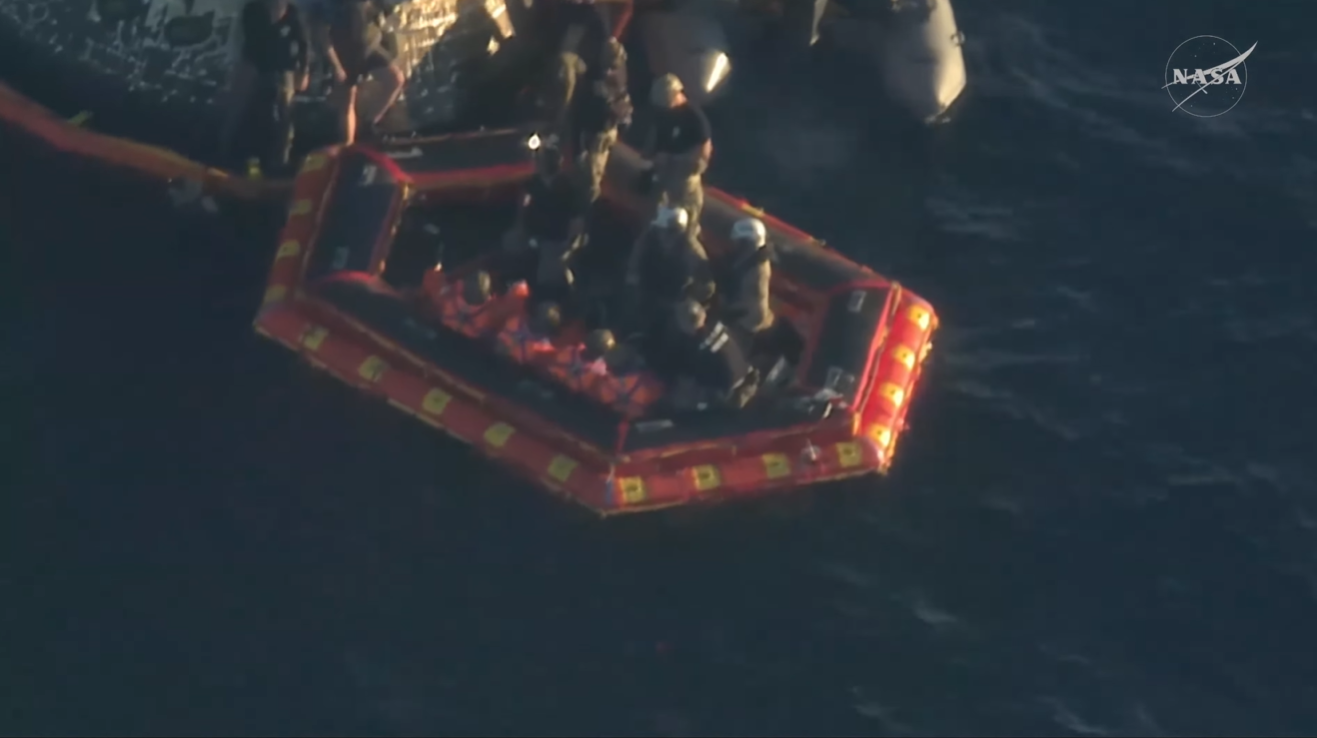
To solve that, the Artemis II recovery plan used an inflatable platform known as the “front porch.” It is deployed just outside the hatch and acts as a temporary staging area for the astronauts after they exit the Orion spacecraft.
That detail explains the entire logic of the timeline. The astronauts are not stepping onto a dry ramp. They are being helped out, transferred to a floating platform, stabilized and then hoisted by helicopter to the USS John P. Murtha, the Navy ship positioned for recovery.
The operation continues even after the astronauts are out
In Artemis II, NASA confirmed the safe extraction of the crew at 9:34 p.m. EDT, more than an hour after splashdown. That sounds slow only if you imagine the job was simply “open the door.” In reality, it reflects a layered operation being executed step by step.
And even then, the work is not over. Once aboard the ship, the astronauts undergo post-mission medical evaluations. After that comes transport back to shore and onward travel to Houston. At the same time, the Orion spacecraft begins its own recovery process: divers attach cables, the capsule is winched into a specially designed cradle in the ship’s well deck, and later it is returned for engineering inspection and data retrieval.
So after splashdown, NASA is effectively running two recoveries at once — one for the people and one for the spacecraft.
Why the protocol matters more than speed
The short answer to the original question is simple: the astronauts did not leave immediately because safety matters more than speed.
But the deeper answer is more interesting. The protocol exists because splashdown does not mean the flight is over in operational terms. There are still medical, chemical and procedural risks that have to be handled with discipline. A mission that looked successful from the outside can still become complicated if those final steps are rushed.
That is why Artemis II treated the return not as a symbolic moment of “open and exit,” but as a high-stakes final phase of the mission.
What Artemis II proved for future missions
This matters beyond one landing. Artemis II was not only historic because it sent humans back into the lunar environment. It also served as a real-world test of the entire deep-space capsule recovery chain.
That includes reentry, splashdown, hazard assessment, onboard medical checks, front-porch egress, helicopter transfer and shipboard post-flight care. Every one of those steps will matter again in future Artemis missions.
Conclusion
The fact that the astronauts did not leave the capsule right away was not a sign of trouble. It was evidence that the protocol worked as intended.
In Artemis II, the crew stayed inside the Orion spacecraft after splashdown because the area had to be secured, chemical hazards had to be checked, the spacecraft had to be configured for recovery, and the astronauts had to be medically assessed before exit.
Put simply: in spaceflight, touching the ocean does not mean the job is done. It means the final, most carefully controlled part has just begun.





Comments
💬 Log in to comment💬 Join the conversation and log in to comment.